
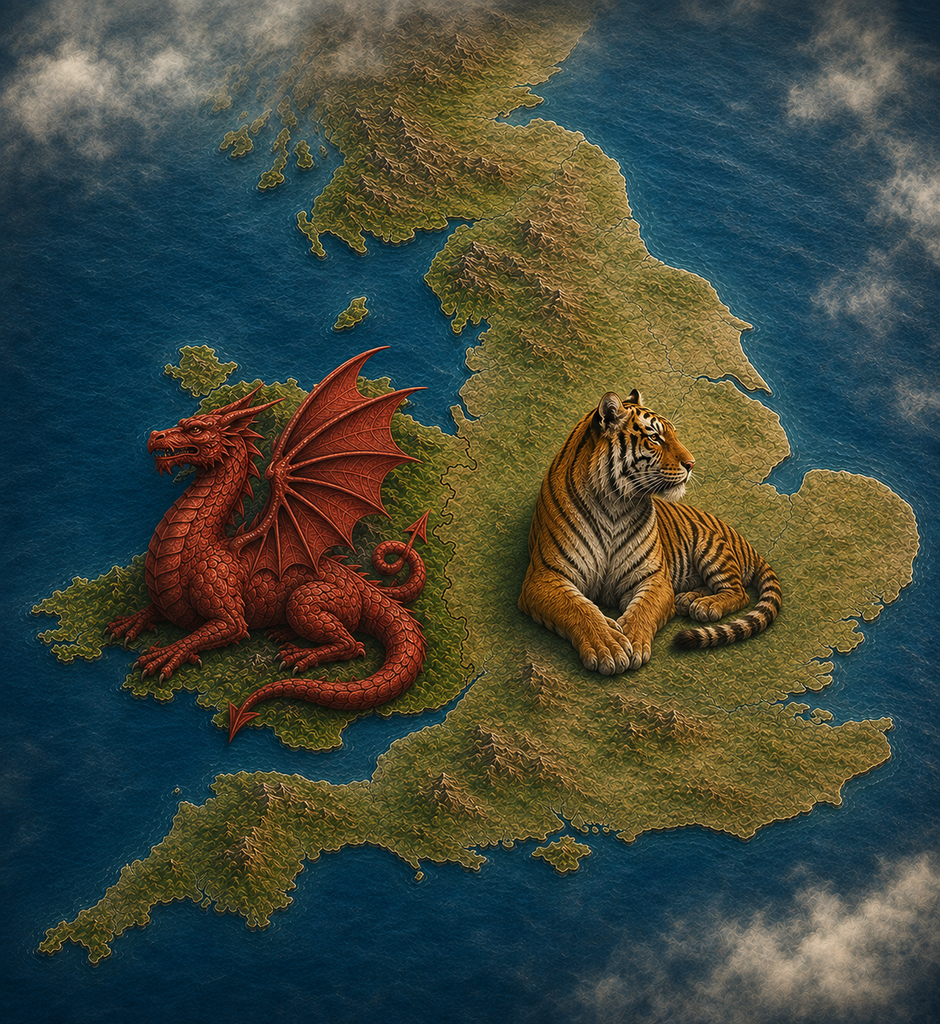
This is a personal piece, much like my previous article. Once again, I want to challenge assumptions about what a supporter of Welsh independence looks like, and to speak particularly to people from backgrounds like mine: English-speaking Welsh people with strong connections east of the border.
I also think both the Welsh and Scottish independence movements have missed an opportunity by failing to embrace Britishness — albeit a Britishness reframed for a post-UK future. After all, Britain is a geographical fact. The political arrangements governing it are not.
The Tiger Next Door
By background and experience, I could easily have become a Unionist. Indeed, at one time I was one.
Much of my professional life has been spent working in England, or remotely for English companies. For years I divided my time between our two countries. England has given me a great deal, professionally and personally, and my feelings towards it are consequently strong and sometimes complicated.
The best metaphor I can offer is this: England is like a tiger. Majestic and awe-inspiring — but you wouldn’t necessarily want to share a living space with it.
The problem is not England itself. It is the sheer imbalance within the United Kingdom.
Consider the routine use of “the North” by the media and government, when what is actually meant is the north of England. Or notice how Welsh or Scottish independence is so often described as separation from England, as though the other nations of the UK barely existed.
England contains around five-sixths of the UK population. Inevitably, therefore, the UK revolves around England.
That isn’t England’s fault. Nor would it be fair to English voters to artificially reduce their democratic influence simply to give the smaller nations equal weight. The imbalance cannot really be fixed within the present structure.
A Neighbour, Not a Ruler
What I want in England is a great neighbour, friend and family member — not the dominant partner in a political union.
I will never regard England as foreign, whatever political arrangements emerge on this island. To me, “foreign” is largely a state of mind. Separate statehood does not require emotional or cultural estrangement.
Indeed, given my own partly English heritage, I would happily seek dual Anglo-Welsh citizenship if such a thing became possible.
But there is an important condition to my affection for England: England is not Britain. England is not the United Kingdom. And England most certainly does not include Wales.
Seen in those terms, what is unreasonable about wanting political independence? It is not hostility towards our neighbour. It is simply a recognition that a country as large and wealthy as England will inevitably dominate a political union with Wales.
My problem isn’t with England or the English. It’s with being governed in a union that England cannot help but dominate.
An Unequal Relationship
The consequences of that imbalance are visible throughout Welsh life.
Our young professionals frequently leave in search of better-paid and higher-quality employment. Meanwhile, parts of Wales increasingly accommodate retirees and economically inactive people arriving from elsewhere in the UK. That is not a criticism of individuals making perfectly rational choices. It is a symptom of an economy that does not offer enough opportunities to its own young people.
Our transport network tells a similar story. Welsh infrastructure has too often been designed around the priorities of an economy centred elsewhere, rather than around connecting Wales to itself.
The same pressures can be seen in prosperous rural and scenic areas, where housing and local economic activity are increasingly shaped by tourism, retirement and inward migration.
Devolution has not solved these underlying problems. The Senedd exercises powers devolved from Westminster, but the fundamental constitutional relationship remains unchanged.
Independence Isn’t Anti-English
Calls for independence did not appear from nowhere. If the United Kingdom worked exceptionally well for all its constituent nations, there would be little reason for serious independence movements to exist.
And this is where my earlier argument about Britishness becomes important. English people who are dissatisfied with the UK’s political structures need not be our opponents. In many respects, they could be our allies.
The end of the United Kingdom could provide an opportunity to rethink government throughout these islands — including England itself.
Paradoxically, although England dominates the UK politically, I think it has also sacrificed something to Britishness.
Wales has at least retained a clearly recognised national identity within the Union. England’s identity, by contrast, has often been absorbed into an overarching British one. One unfortunate result is that even something as straightforward as flying the Cross of St George can sometimes acquire political associations which the Welsh flag generally does not.
England deserves better than that.
A Better Future for England Too
One reason I favour the dissolution of the UK is that I believe it could encourage England to decentralise.
A more federal England, with meaningful power exercised by its regions, could help address long-standing problems such as the North-South divide. It could also allow England to rediscover a national identity distinct from the British state.
I want England’s heritage protected just as strongly as I want Wales’s protected. Nations, languages and cultures have value in themselves. Losing any of them diminishes humanity.
There is no contradiction in loving a country while not wanting to be governed by it.
Nor does shared history disappear when political unions end. When I visit England, I am perfectly comfortable regarding myself as a guest in another nation, just as I would in Germany or Spain. Equally, many English people have made their homes in Wales and become part of Welsh life. I personally know English-born people who cheer for Wales — and some who support Welsh independence.
National boundaries need not be barriers between people.
England Beside Us
So imagine a different relationship.
Imagine an England that no longer governs Wales, but stands alongside it as an equal sovereign state. Imagine cooperation based on mutual interest and affection rather than constitutional obligation.
There is something deeply liberal about that idea: relationships entered into willingly rather than imposed by inherited structures.
Those on the political right who value free markets, limited government and personal liberty might reasonably ask why those principles should stop at constitutional arrangements. Why should a political structure established centuries ago be regarded as permanent simply because it is familiar?
The United Kingdom is not Britain. Ending one does not abolish the other.
Two Nations, Side by Side
There is also another reason why Wales needs to think seriously about its future.
English nationalism plainly exists, and some forms of it increasingly identify England, Britain and the United Kingdom as essentially the same thing. That leaves little conceptual space for Wales as a distinct nation.
If that view of Britishness becomes dominant, Wales faces a choice.
We can continue as a distinctive nation, confident enough to govern ourselves while maintaining close relationships with our neighbours. Or we can gradually become more thoroughly incorporated into an overwhelmingly English political and cultural space.
I know which future I want.
Not a Wales hostile to England, and certainly not one cut off from it. I want a Wales that can meet England on equal terms: two nations with intertwined histories, families, economies and cultures, living beside one another on the same island.
England has been an enormous part of my life. I admire it, enjoy it and feel at home there.
I simply don’t want it running Wales.