
Wales currently generates around 50% more electricity than we use, with the surplus exported to England for little benefit to Wales. A significant part of this (up to 59%) is generated from renewable sources, mostly in the form of wind and hydro power.
Notable renewable sources include:
- The Dinorwig pumped storage hydroelectric scheme with a capacity of 1,728 MW
- The Ffestiniog pumped storage hydroelectric scheme with a capacity of 360 MW
- The existing Gwynt y Môr offshore wind farm off our northern coast with a capacity of 576 MW is the 5th largest offshore wind farm in the world.
- The planned Awel y Môr to be built nearby with a capacity of 500 MW, and smaller schemes are planned off the Pembrokeshire coast with a capacity of 200 MW
- The Pen y Cymoedd onshore wind farm in Neath Port Talbot with a capacity of 228 MW, and there are around 40 smaller farms across Wales with many more planned
But we have not yet taken advantage of our biggest natural asset, tidal power – refer to this earlier article for details. A proposed Severn Barrage could have a projected capacity of between 1,000 and 8,000 MW depending on location, and a proposed Cardiff Lagoon could have a capacity of 3,000 MW with lagoons at Colwyn Bay and Newport having similar capacities. For comparison, the former Wylfa nuclear power station had a capacity of 980 MW and the Hinckley Point C nuclear power station under construction ‘near Cardiff’ will have a capacity of 3,200 MW.
But Who Benefits ?
Power generation for its own sake does not bring many benefits to Wales, with limited long-term jobs, and financial benefits (including tax revenue) typically accruing to corporate offices on the other side of Offa’s Dyke.
Most importantly, we are not developing any added value industry based on this power. A good historical example of this would be Anglesey Aluminium – which relied upon ‘cheap’ electrical power from the nearby Wylfa nuclear power station, but which has since closed. Aluminium production is very heavily dependent on electricity, and the Anglesey plant used to be the single largest user of electricity in the UK needing 225 MW of power, as well as providing 500 well paid local jobs.
In order to ensure the economic viability of an independent Wales we need to develop our industrial base, using value adding industry to build upon the electricity generated from our abundant natural resources.
Future Industry
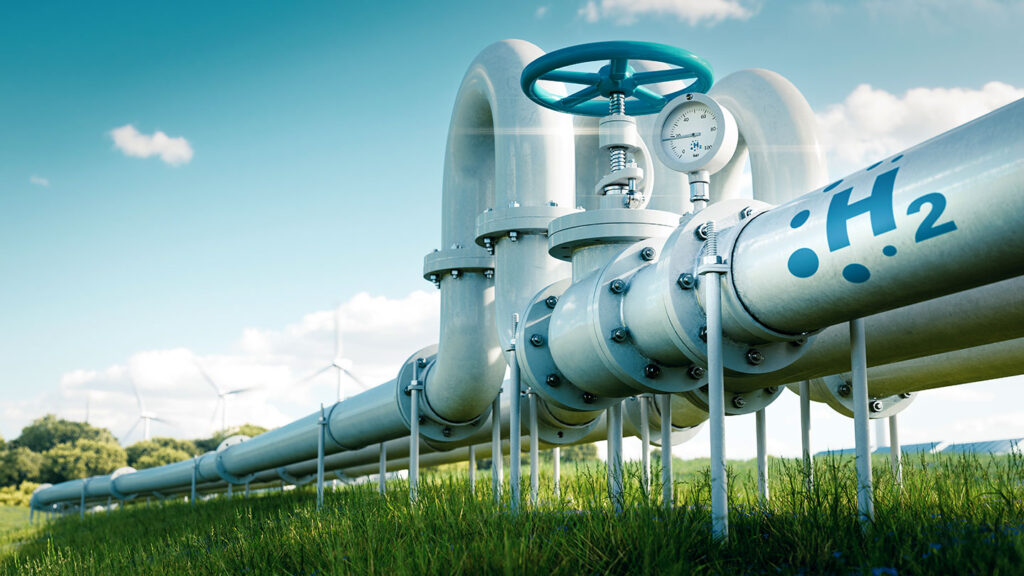
A new developing industry which has a high power requirement is Green Hydrogen – which is widely seen as the fuel of the future. Hydrogen is one of the most common elements on earth, and when combusted as fuel, produces only water as a waste product. There are different methods of Hydrogen production, which are typically referred to by colour:
- White Hydrogen – is extracted from naturally occurring gas deposits, but these are very limited and unlikely to ever be a significant source.
- Grey Hydrogen is currently the most common form of hydrogen production. This applies steam to methane (natural gas) to release hydrogen gas. It is heavily reliant on fossil fuel and also releases carbon dioxide into the atmosphere and it is not considered to be environmentally friendly.
- Blue Hydrogen uses the same technology but in conjunction with Carbon Capture to avoid releasing greenhouse gases to the atmosphere.
- Black or Brown Hydrogen uses the same technology but burns coal or lignite to generate steam and is the dirtiest form of hydrogen production.
- Green Hydrogen is produced by using electrolysis of water to split hydrogen from oxygen, and has the advantage of not generating any carbon dioxide or other pollutants. It is referred to as Green Hydrogen when the power is generated from renewable sources such as wind, solar or hydroelectric.
- Pink or Red Hydrogen also relies on electrolysis but with electricity generated from nuclear power stations.
Green Hydrogen is seen as the fuel of the future but is currently up to 3 times the cost of Grey Hydrogen, although this should change as technology improves and economies of scale are applied. This is already happening and the Neom Green Hydrogen plant currently under construction in Saudi Arabia uses 3,900 MW of solar and wind power to generate electricity and will be the largest such plant in the world, producing 600 tonnes of hydrogen per day. Hydrogen gas has the same transportation limitations as natural gas, but can also be produced as liquid ammonia – which is then transported easily and then converted relatively easily back to Hydrogen gas. This is what is happening here, with ammonia shipped to Europe to meet the growing demand for hydrogen based fuel.
Our Green Future
I see a huge opportunity for Wales as a Green Hydrogen producer as we already have an abundance of renewable energy and water. We could build a hydrogen production facility in say Llanwern – to take advantage of tidal power from nearby Cardiff Lagoon and/or Severn Barrage and exported as ammonia from Newport Docks. We could also base industries nearby that rely on hydrogen itself – like fuel cell technology – and become a global leader in such technology.
Similar integrated production facilities could be built at say Port Talbot, Milford Haven and Holyhead, which all have nearby wind and/or tidal power generating opportunities, as well as existing power transmission lines and port facilities, and are desperately in need of jobs. This would require public investment to create the required infrastructure but the facilities themselves should be financed and operated by industrial operators similar to the structure of the Saudi Arabia venture.