
“A Week in Future Wales” was written in 1957 by Islwyn Ffowc Elis, and imagines life in Wales in the year 2033 – not far away from now.
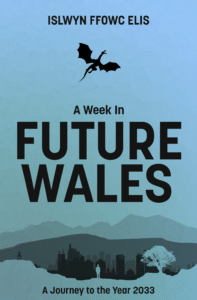
The time-travelling hero, Ifan Powell, makes two separate visits two very different Waleses (if that’s the word). In the first half of the book, he finds Wales as a prosperous independent country, well-governed and with many different parties debating vigorously in its Senedd.
In the second half of the book, he visits again to find that things went a different way: a bleak dystopia with the language long gone, and the population resettled into dense towns and cities. The countryside was given over to trees, mines and reservoirs. Two Westminster parties with little difference between their policies take it in turn to rule, silencing all other voices.
Horrified, Powell asks his guide what happened and how things went so terribly wrong. He was told,
“The old Welsh weakness. Splintering, arguing among themselves, and hesitating… They could have saved themselves. But they preferred to stay in their fools’ paradise, with their little prejudices and low aspirations. And while they hesitated and argued, the English flooded in, the forests were planted, and the valleys drowned. The last of the Welsh woke up too late. Their land and language and nation were gone.”
Like it or not, we Welsh have a terrible reputation for falling out with one another and fighting among ourselves. Princelings battling each other while first the Saxons, and then the Normans, picked them off one-by-one. Nonconformist denominations competing over the size and grandeur of their chapels, scarcely noticing as they drifted further and further away from their Biblical foundations and into the deadly embrace of socialism. And in our age, political factions – tribes, even – hurling insults as the whole of the UK sinks ever deeper into debt and decay.
Ever since Gwlad started up, we’ve often been asked why we want to ‘split the independence vote’ by setting ourselves up as a separate party, rather than working within Plaid Cymru as part of a single movement.
And meanwhile, even within Gwlad, it would be futile to pretend that we all agree among ourselves on every single issue. We certainly don’t: there are hot topics in current affairs where you’ll find Gwlad members taking up positions at opposite poles from one another.
So the challenge is, how do we harness the passions that disagreement generates, and keep things together in a national movement that has some hope of preventing what Ifan Powell found in his second visit to 2033?
Separating Out
To begin with, then, what is the justification for setting up a separate party? Inevitably, in many places we’ll be competing head-on with Plaid Cymru – so why split the pro-independence vote in such a way?
The first thing to say is that Plaid Cymru isn’t necessarily a pro-independence party, and certainly hasn’t always been. Throughout its history it’s vacillated on the issue: when first founded in 1925, it was explicitly against independence but dedicated instead to pursuing the interests of Welsh-speakers while staying within the UK – an approach that hamstrung its appeal to the industrial Valleys for decades. This changed in the 1950s and 60s with thinkers like HWJ Edwards (‘Harri ap Iorwerth’) and, indeed, Islwyn Ffowc Elis, but by the 1980s it again took a back seat as the party moved further and further to the left under Dafydd Elis-Thomas.
Tellingly, the historian Richard Wyn Jones notes[1] that when in 1982 the right-wing ‘Hydro group’ within Plaid Cymru[2] called for “returning to a simple, unconditional commitment to independence” … “they were calling for ‘returning’ to something that Plaid had never in fact believed in”.
And that leads to another problem with Plaid Cymru, namely that even when it has advocated independence it has been a very specific vision of independence: and frankly one that has very little appeal to many people in Wales.
Indeed it is a vision that it’s very hard to see working in practice. It’s founded on socialist principles, even though no small independent country anywhere in the world has ever prospered by going along that path. The only one even to have tried doing that is Cuba, which is indeed admired by some within Plaid Cymru, but very few people will see that as a model they’d like Wales to follow. It is obsessed with the EU, and places great store on Wales being able to rejoin it, despite the enormous practical problems that that would create[3].
But where there’s a single pro-independence party, there will always be people who disagree with its approach. You end up in a situation where asking someone to support independence means asking them to sign up to a whole lot of other ideas which they may well find unacceptable. The ideas themselves may have nothing at all to do with independence per se; but for many voters they are still dealbreakers and drive them into the arms of Unionist parties.
So with a single nationalist party, even if it were unambiguously pro-independence, it’s impossible to capture the support from across the political spectrum which would be necessary to get independence over the line. For that you need another one.
Standing Together
So in our view the case for remaining separate from Plaid Cymru is overwhelming. But what’s to stop Gwlad itself from splitting up into warring factions? It has, after all, been the fate of all too many ‘startup’ political movements over the years.
I know a lot of Gwlad members, and if you were to name just about any hot topic in current affairs outside of Wales, I could quickly find people in the party who hold opposing views.
The war between Russia and Ukraine? Sure. There are some who see it as unacceptable for any large country, ever, to invade a smaller neighbour; especially if the large country in question is a dictatorship to all practical purposes and the small one is a fledgling democracy, however imperfect. On the other hand there are those who see Ukraine as representing all that is corrupt and decayed in contemporary Western society, while Russia stands up to it with a clear resolve and offers certainty based on long-standing traditions.
Israel and Gaza? Absolutely. Some see Gaza as the victim of its larger and much more powerful adversary Israel, bravely standing up against the larger aggressor. While others see Israel as the victim of its much larger and more powerful adversaries in the Islamic world, Iran in particular, for whom Hamas in Gaza and Hezbollah in Lebanon are dangerous proxies. The latter might also celebrate the fact that Israel’s foundation as a Jewish homeland flowed directly from the ‘Cymru Fydd’ movement in Wales at the end of the 19th Century, with Israel following a blueprint that had initially been written for an independent Wales.
But the crucial point about both those matters of disagreement (and many others like them) is that no Welsh government, independent or otherwise, will ever be in the position of having the slightest influence over them. So people can disagree about them without that impacting in any way upon Gwlad’s policies or the way in which a Gwlad government would run Wales.
Then there is the question of ‘moral’ issues – the battlegrounds of abortion[4], sexual identity and so on. This is tricky ground for any party whose ethos is small-c conservative, since ‘fiscal conservatism’ often goes hand-in-hand with ‘social conservativism.’
Certainly, Gwlad is much more tolerant on these issues than most other parties; people who hold socially conservative views are welcome in Gwlad, despite being marginalised in other parties. Even so, in policy terms we prefer to steer clear of such issues where possible, simply because these are areas where any party’s real power is limited. As Andrew Breitbart succinctly put it, “politics is downstream from culture”.
You can’t legislate for morality, and if you try then you quickly end up being like Iran. There are other movements that seek to change the country’s moral climate: many Gwlad members are involved with them also, which is fine, but Gwlad isn’t the channel through which to pursue those interests. In policy terms we’re resistant to further liberalisation in this area, and yet not committed to rolling back previous legislation until society demands it. The only exception to that is on matters that relate directly to the protection of women’s safety and the lives of children: the intrusion of men into female-only sports and protected places, the killing of viable babies right up to birth, and sexual mutilation of young children in the name of the ‘trans’ movement have no place in the Wales that we want to see.
Setting the boundaries
To conclude, the diagram below is a way of summarizing all of this in a way that I find helpful:

No doubt other people could add extra items into each of these four quadrants; no doubt there is scope for disagreement over which things should go into which quadrant – but probably not much.
We all like to be surrounded by people who agree with us – being affirmed by others for our sagacity, and not having to exhaust ourselves fighting our corners all of the time. In the real world, however, for most of us that would mean belonging to a club with just one person in it. To make progress in anything, we have to work with people who disagree with us about some things.
So if someone shares our views on the things in that top-right quadrant, then we don’t much care what they think about things in the other three. They’re welcome to hold their own views and campaign for those views through other channels. But their natural political home, and the party they should support in order to move Wales onwards, is undoubtedly Gwlad.
[1] “Putting Wales First – The political thought of Plaid Cymru” – the quote is my own translation from the Welsh edition of the book, but it is also available in the author’s own English version.
[2] Several of whose members are now in Gwlad, including our party leader Gwyn Wigley Evans.
[3] To name a few:
- Having Wales rejoin the EU on its own would lead to a hard border with England, by far our largest trading partner
- The EU countries themselves make up an ever-shrinking fraction of the world economy, and the EU itself as an organization looks less and less credible, and
- In 2016 a clear majority of Welsh voters chose to leave the EU, and Plaid seems to be intent on alienating – and sometimes even insulting – all of them.
[4] I wrote this paragraph just after Tonia Antoniazzi’s amendment to the Crime and Policing Bill passed, legalizing abortion all the way up to birth; it made me feel physically sick.
1 thought on “Keeping Separate and Standing Together”
I was never convinced about independence in the past, but now I realise, it may not have been independence that scared me, but my confidence as to whether Plaid Cymru could create an economic success.