

What would Wales be like without the Labour Party?
We’ve just had a UK-wide General Election in which the result was a huge landslide for Labour, who gained 211 seats – six of them in Wales. Yet while there was a significant swing to Labour in England and a far larger one in Scotland, Wales bucked the trend: its vote declined by nearly 4% and the seats it acquired were the result of many Conservative voters switching to Reform UK, about whom more later.
This is now the second election in just over five years where Labour has performed poorly in Wales – though the European Parliament election of 2019 still stands out as a historical landmark, Labour having been beaten not only into second but into third place.
Back in May 2019, Allison Pearson wrote some stirring prose in the Daily Telegraph: “…the Brexit Party scorched to 32.5 per cent in the Land of my Fathers, miles ahead of its nearest rival, Plaid Cymru (19.6 per cent). No wonder Stephen Kinnock looked a seasick shade of green on the BBC. Wales had just converted the try, and drop-kicked his Labour party (15.3 per cent) back to its metropolitan madlands. Bloody brilliant, boys!”
At that time, the triumph of the Brexit Party had an air of inevitability about it from the beginning. Plaid’s performance was impressive but still a whole 10% down on the 29.6% vote share they’d achieved in 1999 under Dafydd Wigley. But seeing Labour knocked back into third place for the first time in over 100 years was staggering.
An alien presence
To me the most telling expression in Pearson’s joyful prose is the wonderful phrase “drop-kicked his Labour party back to its metropolitan madlands”, simply because it encapsulates a vital truth: the Labour Party is not native to Wales, it is no friend of Wales, and Wales cannot prosper – indeed, can barely be sure of its survival – unless and until its baleful influence can be brought to an end. They, not the Conservatives, are the real enemy.
How did we get here?
We’ve been told so many times that ‘Wales is a Socialist country’ and have become so used to seeing Labour’s dominance in our national life that it is easy to forget how recent a phenomenon this is.

It is certainly true that Wales has a long history of what I’d call ‘pragmatic radicalism’. As early as the 1830s it was fertile ground for the Chartists. These, despite the occasional flare-up into political violence such as at Newport in 1839, were generally a peaceful movement: for example helping working people to acquire property so that they would thereby have the right to vote. Support for the Chartist General Strike of 1842, which caused widespread disruption across the industrialised areas of England and Scotland, was distinctly lukewarm in Wales.
In rural areas, of course, this was also the period of the Rebecca Riots, which flared in Pembrokeshire, Cardiganshire and Carmarthenshire between 1839 and 1843. These, though, were a very different matter; a movement of the rural workers and farmers, including many people we’d regard today as middle-class, against the poverty of infrastructure and general neglect of the interests of rural Wales.
In Daniel Owen’s thinly-disguised account of the run-up to the Mold Riots of 1869, he stresses how alien the concept of industrial unrest was to the local miners. “But these strikes are a very strange thing” says the wise, godly old chapel elder, Abel Hughes; “They’re things that have come from the English; they don’t belong to us, and I fear that they will do a lot of harm to this country”. The words that Owen puts into the mouth of the (fictionalised) miners’ leader, Bob Lewis, reflect the idea that at root the interests of the workers and the owners were closely aligned with one another, rather than being opposed. The incompetent English middle managers who’d been put in charge of the Caeau Cochion pit were, he said in the same breath, “oppressing the miners and damaging the interests of the owners.”
Generally, as Simon Brooks has pointed out so saliently elsewhere, the overwhelming political force in Wales throughout the 19th and early 20th Centuries was Liberalism; not the authoritarian movement of social-justice warriors with which we associate that word nowadays, but a philosophy which, in substance if not in style, bore far more resemblance to Thatcherism than anything else we’re familiar with today; a belief in individual liberty, the importance of faith and family, free trade, and free enterprise. It’s two most towering figures – William Gladstone in the 19th Century and David Lloyd George in the 20th – were both men of North Wales.
The end of Liberalism
It wasn’t until 1900 that Labour gained its first seat in Wales but they had gained half of the Welsh parliamentary seats by 1922. There were at least four factors that contributed to this rapid advance.
To give credit where it’s due, without doubt one factor was that Labour activists often showed genuine concern for their communities, helping to organise practical relief for the poorest workers at times of particular distress.
Another, related to this, was the fact that the Nonconformist chapel denominations, most of which had been solidly evangelical up to around the 1870s, increasingly lost sight of Biblical teachings in the last quarter of the 19th Century and started to coalesce around new causes, Socialism being one of them (along with Teetotalism, of course).

Thirdly, the Liberal Party almost went out of its way to make itself unpopular: Winston Churchill, as the Liberal Home Secretary (before he defected to the Conservatives) sent the Army in to suppress a riot in Tonypandy in 1910. After the end of the First World War, the party tore itself apart over the question of Home Rule for Ireland, in much the same way as the Conservatives are currently doing to themselves over Brexit (and Labour would be if they were in government).
Fourthly – and I say this carefully, reiterating that Gwlad is not an anti-immigration party – there was mass immigration from parts of England where the Labour Party was already strong. Wales was the only part of the UK to experience net immigration between 1860 and 1914, and at its peak between 1900 and 1914 Wales was receiving more immigration than any other country in the world except for the USA. The great majority of these people came from the southern counties of England, including metropolitan London. Some made a huge contribution to Welsh life – William Hazell, one of the pioneers of the Cooperative movement in Wales who arrived from London in 1906, stands out as an example – but many others brought with them a much more militant strain of Socialism than anything that was native to Wales.
How Labour changed Wales
The result of this shift was that Welsh public life became much more influenced by a statist, centralised approach to industry and society than ever before. In Labour’s hands the Tredegar Medical Aid Society, a shining example of bottom-up community organisation by Liberal Wales, became the centralised behemoth that is today’s NHS; allegedly the envy of the world, though no other country in the world has sought to imitate it. Indeed, every other country in Europe today operates insurance-based health services which are far closer to the spirit of the Tredegar Society, and provide more cost-effective care and better outcomes than the NHS.

As for industry, my colleague Mike Murphy has written about how the post-war Labour government took the successful privately-owned Steel Company of Wales, nationalised it and ran it into the ground, consistently favouring the interests of Yorkshire steelworkers over those in Wales. As for the coal industry, it was already clear to Harold Wilson’s Labour government in the 1960s that coal production in Wales had little long-term future, yet the overwhelming power of the local Labour Party and its associated trade unions in South Wales prevented the orderly transition of the economy to a more diverse base.
Even though Wilson closed more mines than Thatcher subsequently did, he still kept many mines open for much longer than was economically justifiable. It’s interesting to compare and contrast the South Wales Valleys with other regions in Europe which were once heavily dependent on coalmining and steelmaking – Luxembourg, or the Limburg area of the southern Netherlands, for example – which weren’t hotbeds of the sort of militant socialism experienced in Wales. There, governments and communities were able to work together to redevelop the local economies, leading to those areas today having some of the most diverse and prosperous industrial bases in Europe.
And I haven’t touched yet on Labour’s fierce campaign against the Welsh language that lasted most of the 20th Century. Simon Brooks has rightly said that “by the end of the 20th Century, the Labour Party had been more responsible for undermining the Welsh people’s national and language rights than any other institution in the whole of Welsh history.” The way Aneurin Bevan railed against “Welsh-speaking, Welsh-writing zealots” sticks awkwardly in the mind.
The fundamental problem faced by any socialist political party is this: having won political power by appealing to the poor, they can only retain that power by keeping their supporters poor. Make them rich, or even allow them to have the serious prospect of a better life, and they’ll turn their back on socialism and seek a more optimistic alternative. Labour in Wales have proved themselves to be masters at this, portraying themselves as champions of the poor while undermining the Welsh economy in every way imaginable: whether by hindering its industrial development, diverting resources to the bloated Third Sector, undermining its healthcare and education systems, or specifically targeting the least productive people to be imported into Wales whether they want to come here or not. Finally… at last… it’s beginning to look like the game may almost be up.
How Wales can recover
The people who’ve been voting Labour for the last century in Wales haven’t been doing so because they’re wicked or stupid – ‘Morlocks’, as a Plaid Cymru supporter recently labelled the good people of Blaenau Gwent – but because no-one has offered them a viable alternative. None of the other parties have been able to formulate an attractive offer or a positive way forward. And unless there’s a compelling alternative, people do what they’ve always done: party loyalty kicks in, and that’s a difficult thing to shift.

Yet Ifan Morgan Jones, writing on nation.cymru in May 2019 during the hiatus between the European election itself and the announcement of the results, yet knowing what they were likely to be, gave one of the most perceptive commentaries on Welsh contemporary politics I’ve seen for a long time.
“The theory behind Plaid Cymru being the next Welsh Government was that when Welsh voters did eventually, one day, become fed up with Labour that Plaid would get their votes.
This election has cast real doubt on that – and added to my suspicions that it’s small-c conservatism rather than Labour’s socialist principles that has maintained their vote in the valleys for so long.
Plaid Cymru have long sold themselves as more socialist than the Labour Party, banking that an appeal to people’s economic circumstances would sway their vote. But perhaps that simply isn’t what voters have been looking for.
After all, the huge vote for the Brexit Party suggests that people don’t feel that strong an attachment to Labour – when a party has come along that they do prefer, they have voted for it with few qualms.”
What lies beneath
Labour’s success in this year’s election has been described (by so many people that it’s hard to find out who said it first) as “a mile wide and an inch deep“. Lurking just under the surface is the successor to the Brexit Party, namely Reform UK. Though they didn’t win any seats this time around, they took 16.9% of the vote across the country as a whole: a shade behind the Conservatives (18.2%) and well ahead of Plaid Cymru (14.8%).
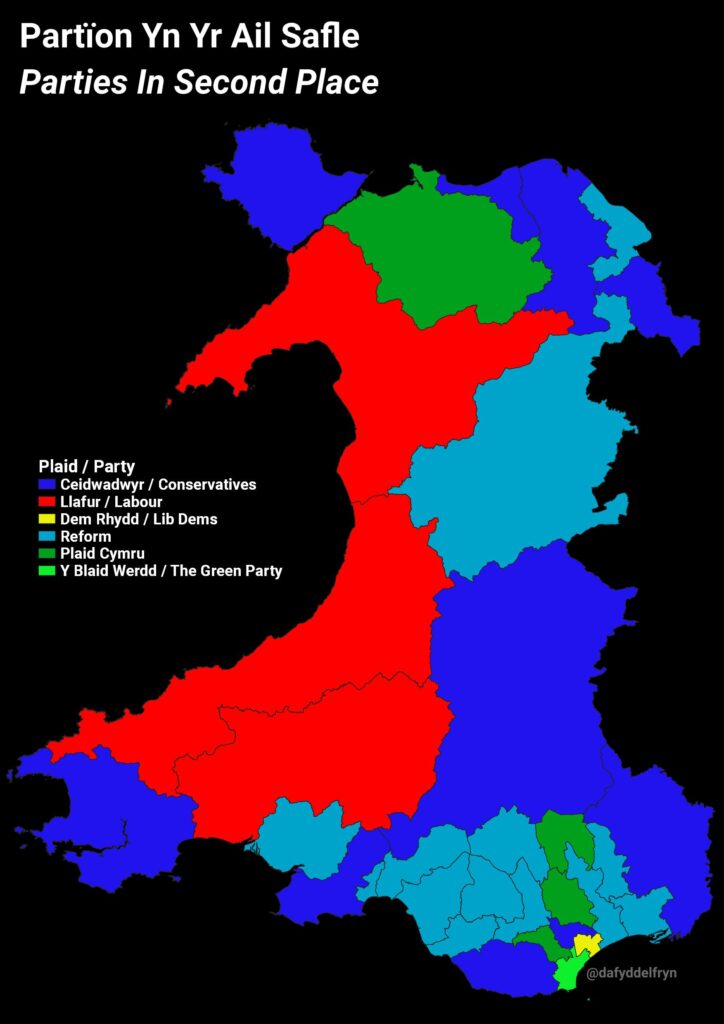
Most tellingly, they came second in a slew of Labour-held seats across Wales, and the Valleys in particular: in Llanelli they came within 1504 votes of winning. In seats where Plaid Cymru have been campaigning for years and hoping to break through, Reform UK has comprehensively leapfrogged them and is now a real danger to Labour in the next Senedd campaign.
This should concern the independence movement because, while Reform may not be as actively hostile to Wales as Labour were for most of their history, they are still a Unionist party with no sympathy for Wales’s national aspirations. If Reform were simply to replace Labour as the dominant party in Wales, just as Labour replaced the Liberals a century ago, it would not actually move Wales any further forward either economically or culturally.
It is therefore absolutely vital that Wales has a strong pro-independence voice which is able to make the case directly to the sort of voters who are moving over from Labour to Reform. Plaid Cymru has nothing to say to these people: they are out of tune with them on Brexit, on mass immigration, and on economics.
Gwlad, however, is well-placed. We acknowledge that Brexit is done and dusted, and see no need to revisit it. While we’re comfortable with immigration at a reasonable level, we’re wholly opposed to mass immigration, to the ‘Nation of Sanctuary’ concept, and especially to having illegal immigrants resettled here from England. On economics, we want to see the economy grow to provide decent, stimulating, well-paid jobs for people, rather than obsessing about Net Zero and so-called social justice issues. In short, we speak their language.
What we lack is the infrastructure. Reform have inherited all the fruits from the ‘hard yards’ that UKIP put in since they were founded in 1991. We started in 2018, 27 years later. We’ve got a lot of catching up to do, and need to grow fast. Now is the time for those who are serious about protecting Wales’s long-term interests to join us.
[In reading the comments below, note that the first seven were made in response to an earlier version of this article published in 2019]
11 thoughts on “Wales Without Labour”
Update:
Though I don’t share her enthusiasm for either the Conservative Party in general or Boris Johnson in particular, Allison Pearson’s column on the day after the General Election is definitely worth a read. Nothing else I read on the day quite captured the sense of joy and release at the thought of what the UK – including Wales – had been delivered from:
https://www.telegraph.co.uk/women/politics/boriss-win-proves-soul-nation-tact-proud-country-has-done/
Any party that wants to dominate politics in Wales in the future is going to need to understand what makes her friend’s Uncle Carl tick.
I wonder whether, given the binary choice, Pearson’s Welshness would win out over her Britishness. Born in Carmarthen to English parents, and moved to Market Harborough in Leicestershire as a child. She doesn’t strike me as any friend to our cause, given the cloying, excessive Brit-patriotism, ridiculous melodrama, probably fabricated anecdotes and Conservative Party hagiography in that article, I’m sorry to say. The woman is also something of a crank from what I’ve read, and incidentally was declared bankrupt in 2015. There’s your commitment to conservative tenets of individual responsibility and accountability(!).
What makes Uncle Carl tick, I’d wager, is the Red Tops, a simple and easily digestible campaign slogan (in fairness a masterstroke) and his wanting of critical capacity. It’s a brilliant con-trick these Brexiteering Borisites play, the singling out of cohorts such as the ‘Metropolitan elite’, Brussels, etc, while being totally blind to the egregious and entrenched eliteness of the upper echelons of the Conservative Party. I also question how much antisemitism factored into the concerns of people like our author before it became a stick to beat Labour with. Granted, it is no friend to Wales, but in no way are the Borises and Farages of the world. Of course, into this void there is plenty of room for Gwlad to grow in. I’d be interested to get your take on Brexit, as I gather you’re against the EU but I’ve not seen anything written in which your stall is set out.
As for Allison Pearson, only she can answer those questions, but I don’t think her loyalty to Wales is in any question. She regularly identifies herself as Welsh in her writing, and diligently follows a large number of Wales-related accounts on Twitter (including my own).
If I were to take a guess, I’d put her in that – really quite large – category of Welsh people who are patriotic about Wales, but support the Union at least in part (perhaps even, mainly) because they see it as a bulwark against Wales becoming a Labour one-party state, dominated by the type of radical socialists who tend to make the most noise within the nationalist movement, despite still being relatively few in number.
As I’ve often said, my own belief is that an independent Wales would be significantly more conservative than it is at present, partly because the Welsh Labour party would quickly wither under the amount of scrutiny it would get in an independent country, and partly because the ‘conservative’ brand would no longer be convoluted with (and tainted by) the ‘Tory’ brand.
Very quickly regarding Gwlad and Brexit, we have within our ranks rampant Brexiteers (frankly, I’m one) and committed Remainers. What unites us is the observation that Wales voted for Brexit, unequivocally, it’s a political reality, and even if Wales wanted to rejoin the EU then we’d be ill-served by having the England-Wales border acting as the EU frontier.
I got quite the flavour of chest-beating British Nationalism from that article, with its tedious references to the ‘British nation’ and how it finally got what it wanted, despite half the nations in this union *not* wanting it. Brexit, and Wales voting for it aside, this sort of homogenising Britishness should be anathema to everything Gwlad is about.
The fear of perpetual Labour rule is a fallacy, one easily straightened out by asking why affluent areas in the South of England for example vote Conservative. Growth of our own economy and enterprise will undoubtedly bring about a shift away from Labour, as you say. This is not a difficult set of logical steps to follow for an ostensibly intelligent woman.
I voted remain, but for pragmatism as much as anything else, I’d be happy for Wales to stay out. An open border or trade agreement with England makes far more sense than one with France. Scotland would have an easier time returning to the EU, as their border with England is much shorter, less complex and has fewer population centres nearby on either side. It makes greater sense in the case of an United Ireland inside the EU.
I’m guessing you see the EU as eroding national sovereignties. I always saw it as a sort of halfway house between unfettered free trade and full-on, ‘doors shut’ protectionism. One thing I do appreciate greatly about it is its spirit of co-operation and sharing between countries, a spirit I’d love to see emulated between an independent Wales and her neighbours.
As regards the modernisation and diversification of the Luxembourgish and Dutch economies to offset the decline of coal mining: could this be paralleled with how London’s Docklands, in the face of containerisation, were modernised to a phenomenally successful degree with a shiny new financial services centre called Canary Wharf? Only in a month of Sundays would Welsh mining towns have had anywhere near this level of due care and stewardship, to weather the storm of transition to more modern economic activity within the British State. Perhaps, radical socialism was felt to be the only option; exerting itself at once as an effect, as much as a cause for anything. These places sure as hell could never have effected shift in orientation by policymakers towards their interests at the ballot box.
That’s a tricky one. Cardiff Bay, of course, had a phenomenal amount of money pumped into it, though still chicken feed by comparison with what Canary Wharf had. It’s hard to imagine spending on that scale being committed to the Valleys, but the attitude that was prevalent there throughout the 1980s and 90s – a combination of implacable hostility to the government of the day combined with unconditional loyalty to the Union (and the Unions, all of whom had failed to deliver on their promises) – meant that the government had no incentive to lift a finger to help.
I’m quite certain that, if most Valleys seats had been Conservative / Plaid Cymru marginals, then the story would have been very different indeed. It was the case then, as it has been throughout the 20th Century, that it was the Labour Party that held Wales back.
So no blame falls at the Conservatives’ door then? Instead of being a government for all, they only looked after ‘their’ people and only if there was to be something in it for them electorally.
I thought this article was brand new, until I scrolled to the comments and realised I’d already read and discussed it with yourself almost 3 years ago Stephen! I wanted to comment this time around, that the URL filtering by author doesn’t seem to work, so /author/stephenm/ returns articles by everyone it seems.
I believe Labour will be in serious trouble at the 2026 Senedd Election. Ominously for Labour this will roughly coincide with the UK government’s ‘mid-term’ period, where ruling parties usually enter the doldrums. We all know that Senedd elections are greatly influenced by the public’s attitude to the ruling party in Westminster, our population taking a realistic view as to where the power today really lies (economically at least) despite devolution. However long before mid-term, Labour’s popularity is already going off more quickly than ripe cheese. Everyone has noticed that Starmer has had the shortest ‘honeymoon period’ in recent political history. This is not surprising when we consider that Labour’s UK victory is actually very hollow. There was a UK wide desire to be rid of the Tories, this and fracturing of the traditional political ‘Right’ brought Starmer to victory, not any great popular surge for his hard boiled woke progressive programme. By 2026 Starmer’s new austerity measures will be in full force, so he had better hope that his other manifesto promises are being realized. There is plenty of reason to believe the rest of Labour’s UK Manifesto will also be found dead on arrival.
If any proof was wanted of the injustice of the Westminster voting system, one can point to the fact that Labour won its huge majority with a barely higher vote share than in its ‘disastrous’ election of 2019, at just 33.7% of the vote. In Wales it is apparent the ‘tribal loyalty’ that has kept Labour in power for so long is crumbling, especially in its old heartlands of the South Wales valleys. Once the former loyalist base gets out of the habit of voting Labour, many will not return.
Labour is threatened by a pincer movement from the Left and the Right. It seems likely that in 2026 the Greens and Plaid will make major inroads, and unless the Conservatives in Wales get their act together very quickly (which is unlikely), then Reform will both replace them and take many Labour votes too. Not voting for Labour is not such a leap for many a proud Welshman but they will actively sit on their hands in preference. Actually voting Tory has seemed for a very long time like a mini act of treason. Reform doesn’t have the same baggage as the Tory party. Labour will almost certainly lose its governing majority in the Senedd, but unless the Lib Dems make a good showing too then we may see a fractious Rainbow Plaid-Green-Liberal and/or Labour Alliance. Alternatively politics in the Senedd may simply be moribund, as the latter parties will refuse to work with the Tories and especially Reform. It remains to be seen whether the D’Hondt method will deliver any seats to very small parties. It’s not likely. Personally, I’m for a Single Transferable Vote system. I view the system we are being offered in 2026 as nothing short of capricious gerrymandering by the big parties.
I take it Gwlad is playing a very long game in trying to carve out a political territory for itself. It is not immediately obvious where the political ‘gap’ will emerge for your party to be thrust forward into greater limelight. It will take I feel the collapse of both the Tories and a disintegration of Reform (maybe post-Farage) and for a much larger section of the Welsh population to finally be fed up with the endless corruption and shenanigans in Westminster. That day may come rather sooner than expected. I am inclined devo-maximalist tending to the Indy-Curious. But I’m slowly, cautiously, concluding with many all over this island that the time is up for the constitutional settlement of UK Inc., one way or another. Indeed it could just as easily come about from England wanting to be rid of Wales as Wales demanding independence from England. In my mind that process of de-unionization has to some extent been catalysed by the succession of Charles III to the throne. In person and not just de jure, Elizabeth II had a loyal following, but without that personal loyalty the instinctive loyalty of Welsh traditionalists to the British Crown is rapidly dissipating. But my overall reason for voting for pro-unionist parties has indeed been to prevent Wales becoming a soviet style socialist republic with the barmiest of economic and social policies. I love the idea of an independent Wales in abstract, but I know at the moment at least an independent Wales would be one dominated by euro-communists with a nasty authoritarian streak. Better the devil and all that.
From your many tweets and articles, I believe Gwlad have successfully identified the many sclerotic features of our one-party state and socialist politics in Wales which have economically and socially weakened what should be a proud nation. As to the solutions, you have many policy positions that I like. I was an SDP supporter but I find myself these days closer to Reform politically (though not a registered supporter). I describe myself now as a ‘national conservative’ but this does beg a question of what exactly I mean by ‘national’. The UK is the political state, but Wales could be its own nation entire. I’m more naturally patriotic about Wales and struggle to extend those feelings to the UK state. In any event neither the Tories nor Reform can provide a satisfactory long term programme to transform Wales. Worse, from many conversations with supporters, I think Reform’s rank and file is probably not only pro-Unionist but even anti-devolution. Reform may only replace Socialism with Westminster-orientated Hyper Thatcherism. Many commentators have noted that the ‘sweet spot’ of UK British politics tilts to the left on economic matters and to the right on cultural issues. I’m not sure if this is also true of Wales. I suspect that the Welsh may be rather harder to wean off socialist dependency, but it must be done.
With a cold and objective eye, it’s clear to see that what ‘Mrs Windsor’ overwhelmingly had in her favour in terms of public sentiment was her tenure, the fact that she was around for so long. Beyond that, what did she invent, discover, create or introduce? Absolutely nothing.
DEMOCRACY; A DIRTY WORD IN WALES
I left Labour having been President of Torfaen Constituency Party and Chair of the Labour party…because it did not meet the needs of the majority of the people. I joined UKIP not because I hated the Europeans, but because it was a cumbersome and inward-looking organisation that threatened democracy, the UK in particular. Now the threat comes from inside?
Another nail in the coffin of Welsh democracy was hammered home with the publication of the Democracy and Boundary Commission Cymru proposals for the new “super constituencies” that will be used to elect the expanded Senedd of 96 Members in 2026. No criticism should be made of the Commission – its members have done the job they were told to do. But the outcome is a dog’s dinner that is likely to result in greater alienation of the people of Wales from the national parliament that is meant to serve them. Instead of having one constituency Member to represent them, as happens under the present system, there will be six. Of course there are also four regional Members under existing arrangements, but they tend to be seen – at least from a constituency perspective – as incidental add-ons rather than core to the task of representation.
This is a complete ‘stitch up’ between Labour & Plaid Cymru, who put their survival before their country…and for this they should hang their heads in shame!
By electing six MSs from a Closed List system where people vote for a party rather than an individual, the crucial personality element of politics is being eliminated. Individuals will be elected to the Senedd not because of their appeal to voters or work they have done, but because they have played the system within their party to ensure they are at the top of the Closed List or close to it.
Who will secure the “top seed” places? People who are regarded as loyalists to the party tribe who will not just follow the party whip come what may, but actively work to ensure that what the party hierarchy wants, the party hierarchy gets. For any maverick who does manage to get selected, there will be the constant threat of deselection if they step out of line.
You can only judge people by the friends they keep? Labour holds onto power through the use of lobbyists, a tame media, opposition parties incapable of mounting effective opposition, crony-run third sector organisations and other bodies the ‘Welsh Government’ funds to tell it what it wants to hear.
Wales are Ruled By Pressure Groups, the influence exerted over our tribunes by outfits like Extinction Rebellion, 20’s Plenty for Us, WWF, Friends of the Earth and Sustrans.
The advantage of this relationship for the ‘Welsh Government’ is that it can quote these organisations as “experts“, in order to push on with plans and projects that had already been mutually agreed.
You can only judge people by the friends they keep? Labour holds onto power through the use of lobbyists, a tame media, opposition parties incapable of mounting effective opposition, crony-run third sector organisations and other bodies the ‘Welsh Government’ funds to tell it what it wants to hear.
Wales are Ruled By Pressure Groups, the influence exerted over our tribunes by outfits like Extinction Rebellion, 20’s Plenty for Us, WWF, Friends of the Earth and Sustrans.
The advantage of this relationship for the ‘Welsh Government’ is that it can quote these organisations as “experts“, in order to push on with plans and projects that had already been mutually agreed.